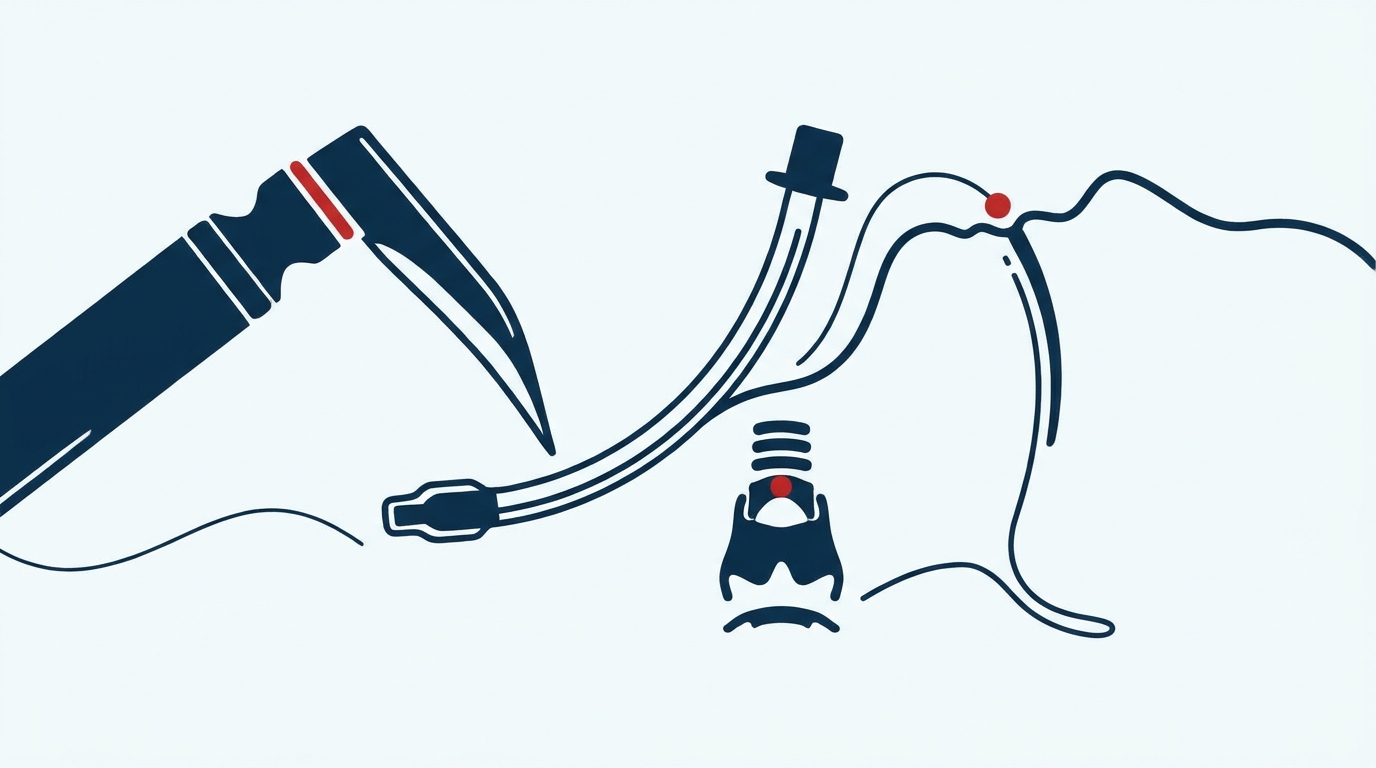
Context: What a supraglottic airway device is for
A supraglottic airway device (SGA) sits above the glottis and seals the hypopharynx or periglottic space. It allows ventilation and oxygenation without passing the level of the vocal cords. In emergencies, its main advantages are rapid insertion, no need for laryngoscopy, and that the technique is learnable.
At the same time, an SGA is not a definitive airway. It protects against aspiration less well than a cuffed tracheal tube. The quality of the seal depends on size, position, depth of anaesthesia and airway pressure. In practice, the SGA is a tool for bridging and rescuing oxygenation. It does not replace planning for further airway management.
First- and second-generation SGAs are distinguished. Second-generation devices have a gastric drainage channel and are usually designed for a better seal. A second-generation device is explicitly recommended for the difficult airway [83].
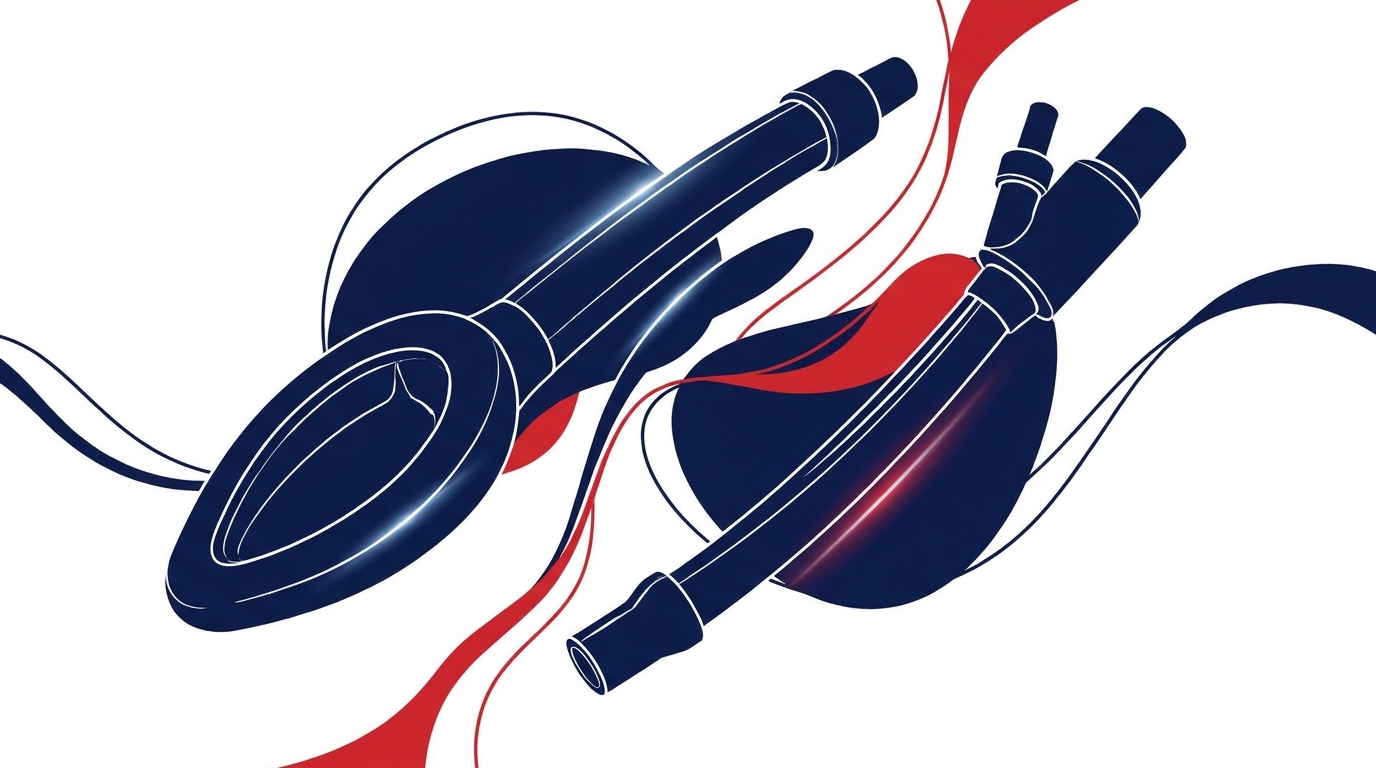
Laryngeal mask and laryngeal tube compared
| Feature | Laryngeal mask | Laryngeal tube |
|---|---|---|
| Principle | Mask body surrounds the laryngeal inlet | Tube with pharyngeal and oesophageal cuff, ventilation outlet between them |
| Seal | Perilaryngeal (cuffed or cuffless) | Two cuffs, inflated via a common pilot line depending on the model |
| Gastric access | Via drainage channel in second-generation models | Via drainage channel in second-generation models |
| Intubation through the SGA | Possible with suitable models, usually fibreoptically guided | Limited depending on the model; follow manufacturer's instructions |
| Size selection | Usually by body weight | Depending on the model, by height or body weight |
| Typical strength | Widely used in anaesthesia and paediatric anaesthesia | Simple "blind" insertion, widely used in prehospital care |
The available evidence does not allow a general conclusion about which system is superior in a given case. What matters is availability within one's own system, the team's routine and standardised equipment. Services that stock both systems should train regularly with both.
Indications
Anaesthesia and emergency anaesthesia: Plan B
In the Difficult Airway Society algorithm (DAS 2025) for unanticipated difficult intubation, the second-generation SGA is an integral part of Plan B [83]:
- Plan A: Intubation, preferably with a videolaryngoscope. Limit the number of attempts and optimise each attempt.
- Plan B: Second-generation SGA, also with a limited number of attempts. If oxygenation is adequate, pause and decide: wake the patient, intubate via the SGA or proceed with the SGA.
- Plan C: If adequate oxygenation cannot be achieved, a final attempt at facemask ventilation follows. This is performed two-handed with an oropharyngeal or nasopharyngeal airway, ensuring full neuromuscular blockade.
- Plan D: In a "can't intubate, can't oxygenate" (CICO) situation, emergency front-of-neck access (eFONA) is performed immediately: cricothyroidotomy using the scalpel–bougie–tube technique.
The second-generation SGA should therefore be ready as Plan B before induction. Plans A–D are discussed within the team before the first drug is given. Every change of plan is announced aloud, and oxygen delivery continues throughout all attempts.
After neuromuscular blockade with rocuronium, sugammadex can reverse muscle relaxation. However, it does not resolve swelling, blood or difficult anatomy as the cause of the airway problem. In CICO, sugammadex is not a reliable rescue and must not delay cricothyroidotomy [83].
Resuscitation
During resuscitation the airway is secured in a stepwise manner, adapted to the patient, the situation and the team's experience. The ERC Guidelines 2025 are authoritative. Details and grades of recommendation should be taken directly from the guideline.
The following points are relevant in practice:
- An SGA can often be inserted with no or only minimal interruption of chest compressions.
- For teams without regular intubation practice, the SGA is often the more realistic option for an advanced airway.
- Comparative studies of SGA versus intubation in cardiac arrest show no clear superiority of either strategy. The evidence is limited and partly inconsistent.
- Whether continuous compressions with asynchronous ventilation are possible after insertion depends on the seal. If there is a relevant leak, ventilation is resynchronised, with pauses in compressions according to ERC 2025.
- Capnography is used to confirm placement and for ongoing monitoring.
Limitations and relative contraindications
An SGA requires particularly careful consideration in cases of:
- high aspiration risk, such as non-fasted patients or ileus, outside a rescue situation,
- the need for high airway pressures, such as severe obstruction, low compliance or obesity,
- pathology at glottic or supraglottic level, such as swelling, tumour or trauma,
- limited mouth opening.
In a rescue situation, i.e. Plan B or impossible facemask ventilation, oxygenation takes priority over these concerns.
Size selection according to the manufacturer
There is no uniform sizing system across manufacturers for SGAs. Size is determined exclusively by the instructions for use of the specific model:
- Laryngeal masks are mostly selected by body weight.
- Laryngeal tubes are selected by height or body weight, depending on the model.
- Size information is usually printed on the packaging and the product. It should also be recorded in the local SOP or on a card in the emergency bag.
- If the value lies at the boundary between two sizes, the adjacent size should be readily available.
- Cuff inflation volume or cuff pressure should also be limited according to the manufacturer. Where possible, pressure is measured rather than estimated.
Special considerations in children
In children, the actual weight should always be used if known. If unknown, it can be estimated using the APLS formulae [148]:
- Infants: 0.5 × months + 4 kg
- 1–5 years: 2 × age + 8 kg
- 6–12 years: 3 × age + 7 kg
From puberty onwards, the actual weight should be ascertained.
Tidal volume is guided by a target range of 6–8 ml/kg ideal body weight. It is adjusted according to chest rise, lung mechanics and capnography [2]. A leak during ventilation is more common with SGAs in children, so airway pressures require particularly close monitoring.
Insertion and confirmation of placement
- Preparation: Check the size, test and fully deflate the cuff, apply lubricant according to the manufacturer's instructions, have suction ready.
- Depth of anaesthesia: Anaesthesia that is too light promotes coughing, gagging and laryngospasm. This also applies to emergency anaesthesia.
- Insertion: Follow the hard palate and observe the manufacturer's markings. With the laryngeal tube, insertion depth is particularly important.
- Cuff inflation: Inflate according to the manufacturer's instructions, then measure cuff pressure.
- Confirmation of placement:
- capnography over several breaths,
- symmetrical chest rise and auscultation,
- audible leak from the mouth,
- plausibility of airway pressures.
- With second-generation models: Consider passing a gastric tube through the drainage channel. Free drainage provides additional support for correct placement.
- Securing the device and a bite block should not be forgotten.
Common pitfalls
Size and equipment
- Wrong size: too small leads to leakage, too large to malposition and mucosal pressure.
- Manufacturer's instructions are not followed; sizes of different systems are confused.
Insertion
- The epiglottis is folded or pushed down. The result is obstruction despite apparently correct placement.
- Laryngeal tube too deep or too shallow: the oesophageal cuff obstructs the laryngeal inlet, or the ventilation outlet is malpositioned.
- Repeated, non-optimised attempts instead of a clear change of plan according to DAS 2025 [83].
Cuff inflation and ventilation
- Overinflation without pressure measurement. This can worsen the seal and damage the mucosa and tongue; the risk increases with duration of use.
- High airway pressures lead to gastric insufflation, regurgitation and aspiration.
- The drainage channel of second-generation models is left unused.
Monitoring and team communication
- No capnography. Malposition and dislodgement, for example during repositioning or transport, then go unnoticed.
- "Pause and decide" is missed: a functioning SGA tempts the team to carry on without consciously determining the further strategy.
- Cricothyroidotomy is delayed when the SGA also fails to achieve oxygenation.
Practical summary
- The second-generation SGA is the established Plan B in emergency anaesthesia. It is ready before induction and discussed within the team.
- Whether laryngeal mask or laryngeal tube: routine, standardised equipment and regular training matter more than the model.
- Size is selected exclusively according to the manufacturer's instructions; cuff pressure is limited according to the manufacturer and measured.
- Capnography is mandatory with every SGA.
- In resuscitation, the SGA is a guideline-supported option. Evidence comparing it with intubation remains limited.
- If oxygenation fails, CICO is declared early and cricothyroidotomy is performed without delay.
References
- [83] Difficult Airway Society 2025 guidelines for management of unanticipated difficult tracheal intubation in adults. Br J Anaesth 2025 (Epub 07.11.2025), Algorithmus Plan A–D.
- [2] Djakow J, Turner NM, Skellett S et al. European Resuscitation Council Guidelines 2025 Paediatric Life Support. Resuscitation 2025;215 Suppl 1:110767.
- [148] Advanced Life Support Group (ALSG). Advanced Paediatric Life Support (APLS) – A Practical Approach to Emergencies. Altersformeln zur Gewichtsschätzung.
This article does not replace clinical judgement in the individual case or the current summary of product characteristics and guidelines.