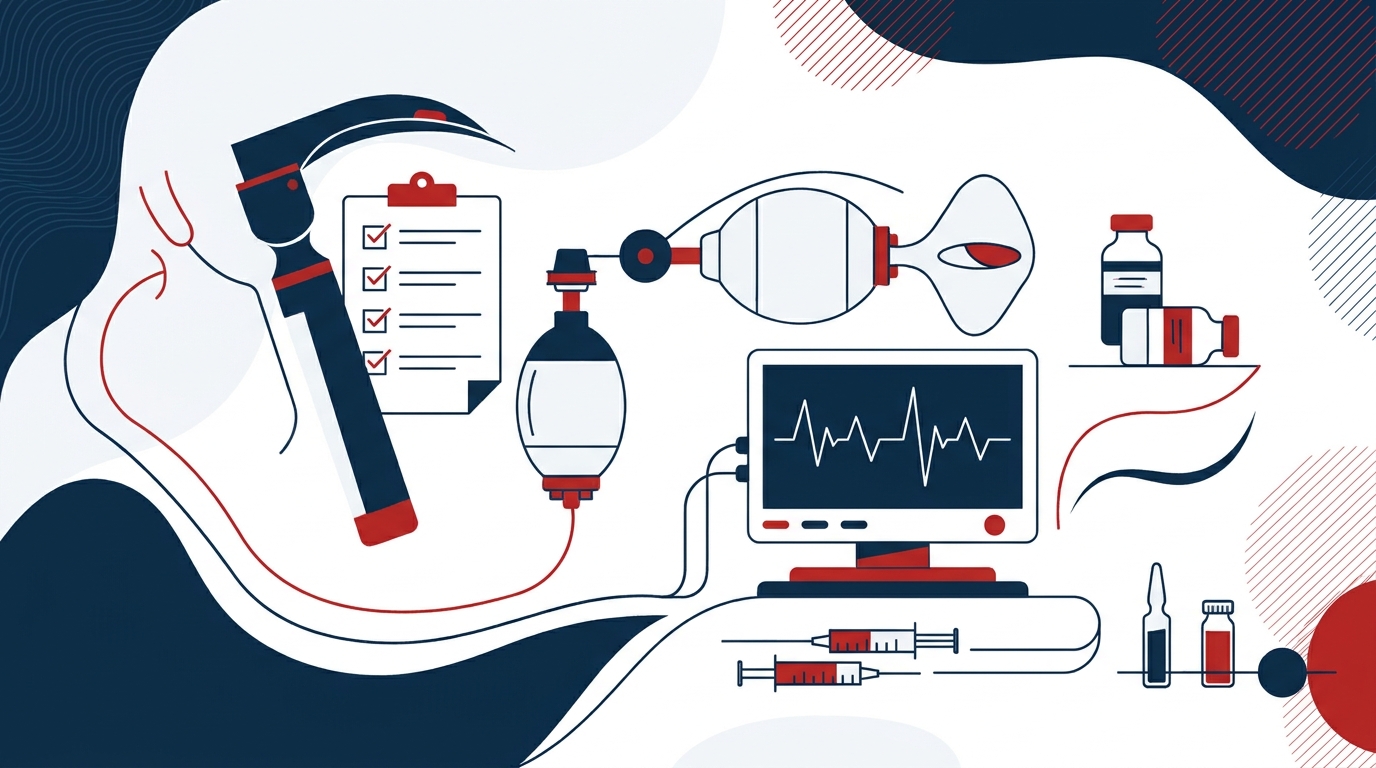
Principle: prepare first, then induce
Emergency anaesthesia as rapid sequence induction (RSI) is usually performed under unfavourable conditions, whether pre-hospital, in the resuscitation room or in the intensive care unit:
- Patients are often not fasted.
- Many are haemodynamically unstable or hypoxaemic.
- The airway is frequently unknown.
Errors rarely arise from a lack of knowledge. More often, structure, equipment or an agreed fallback plan is missing.
The central principle is therefore: Plans A, B and C are discussed before the first drug is given, and the equipment is ready. A checklist read aloud makes this preparation verifiable for the whole team.
Pre-induction checklist
Before every emergency anaesthetic, the following items should be worked through and confirmed:
- Team: indication clear, team informed, roles assigned and stated aloud
- Monitoring: ECG, SpO₂, blood pressure at short intervals, capnography
- Access: secure, running access, preferably two
- Preoxygenation: at least 3 min with FiO₂ 1.0 via a tight-fitting mask, alternatively NIV or high-flow
- Positioning: head and torso elevated, ear level with the sternum
- Suction: ready for use
- Airway equipment:
- Laryngoscope or videolaryngoscope
- Tracheal tubes in two sizes
- Stylet or bougie
- Cuff syringe and tube fixation
- Fallback plan: Plan B (supraglottic airway) and Plan C (cricothyroidotomy set) within reach
- Drugs: drawn up and labelled, vasopressor ready
- Reversal agent: sugammadex available if rocuronium is used
The checklist does not replace clinical assessment. It does, however, reduce the risk of overlooking individual items under time pressure, such as missing capnography or an unprepared cricothyroidotomy set.
RSI procedure step by step
1. Briefing and role allocation
Before induction, the team leader states:
- the indication,
- the planned drugs,
- the airway strategy,
- the abort criteria.
Each role is assigned to one person: airway, drugs, monitoring and assistance. Only then is it clear in an emergency who initiates and performs the switch to Plan B or C.
2. Preoxygenation and positioning
Preoxygenation is performed for at least 3 min with FiO₂ 1.0 and a tight-fitting mask. If oxygenation is impaired, NIV or high-flow may be considered. A tight mask seal is crucial. A leaking mask considerably reduces the effect of preoxygenation.
For positioning: head and torso elevated, ear level with the sternum. This position facilitates laryngoscopy and supports oxygenation.
3. Induction
The hypnotic and the neuromuscular blocking agent are administered in rapid succession. The dose depends on body weight, haemodynamic status and age. The vasopressor should already be drawn up at this point, as hypotension after induction is common.
4. Intubation and confirmation of tube position
Laryngoscopy is performed directly or with a videolaryngoscope, depending on experience and equipment. Tube position is confirmed by capnography over several breaths and supplemented by auscultation.
Rapid sequence induction: drugs and doses
The following doses refer to intravenous administration in adults and correspond to the respective summaries of product characteristics.
| Drug | IV dose | Concentration | Comment |
|---|---|---|---|
| Esketamine | 0.5–1 mg/kg | 25 mg/ml | haemodynamically stable, preferred in shock |
| Propofol | 1.5–2.5 mg/kg | 1% = 10 mg/ml | reduce markedly in hypotension/hypovolaemia |
| Rocuronium | 1 mg/kg | 10 mg/ml | often 1.2 mg/kg (off-label); reversible |
| Suxamethonium | 1–1.5 mg/kg | 2% = 20 mg/ml | observe contraindications (hyperkalaemia, malignant hyperthermia) |
| Sugammadex | 16 mg/kg | 100 mg/ml | emergency reversal after rocuronium 1.2 mg/kg |
Hypnotics
Esketamine is considered haemodynamically stable and is preferred in shock. The IV induction dose is 0.5–1 mg/kg. If venous access is not possible, the summary of product characteristics gives 2–4 mg/kg IM.
Propofol is dosed at 1.5–2.5 mg/kg IV. This applies to adults under 55 years of age. It is titrated, for example 20–40 mg every 10 s. In hypotension or hypovolaemia, the dose must be reduced markedly. Particular caution is therefore required in critically ill patients.
For the accompanying analgesic and the vasopressor, the drug and dose should be taken from the current summary of product characteristics or the local standard.
Neuromuscular blocking agents
Rocuronium is given in the summary of product characteristics as 1 mg/kg. In emergency practice, 1.2 mg/kg is frequently used. This is off-label. A major advantage is reversibility with sugammadex. Rocuronium should therefore only be used if sugammadex is available.
Suxamethonium is dosed at 1–1.5 mg/kg. Contraindications must be strictly observed, in particular:
- Hyperkalaemia
- Susceptibility to malignant hyperthermia
The choice of neuromuscular blocking agent depends on:
- the contraindications,
- the availability of sugammadex,
- the experience of the team.
A general superiority of either agent cannot be derived from the evidence presented in this article.
Emergency reversal with sugammadex
For immediate reversal of neuromuscular blockade, for example in a "cannot intubate – cannot oxygenate" situation, the summary of product characteristics gives 16 mg/kg IV as a bolus. This applies after rocuronium 1.2 mg/kg.
Important: reversal only ends the neuromuscular blockade, not the hypnosis. Nor does it replace escalation to Plan B or C.
Worked example: 80 kg body weight
| Drug | Dose | Volume |
|---|---|---|
| Esketamine (25 mg/ml) | 40–80 mg | 1.6–3.2 ml |
| Propofol 1% (10 mg/ml) | 120–200 mg | 12–20 ml |
| Rocuronium (10 mg/ml), 1 mg/kg | 80 mg | 8 ml |
| Suxamethonium 2% (20 mg/ml) | 80–120 mg | 4–6 ml |
| Sugammadex (100 mg/ml), 16 mg/kg | 1280 mg | 12.8 ml |
Weight-based tables for other body weights can be found in the chapter "Emergency anaesthesia & RSI" of the compendium.
Airway strategy: Plans A, B and C
A structured airway strategy is defined before induction and stated aloud within the team:
- Plan A – tracheal intubation:
- Laryngoscope or videolaryngoscope
- Stylet or bougie
- Spare tube in a second size
- Plan B – supraglottic airway: This serves to maintain oxygenation if intubation fails.
- Plan C – cricothyroidotomy: This is indicated if neither intubation nor oxygenation via a supraglottic airway is possible. The set is ready before induction, not only when needed.
The decision to move to the next plan should not be delayed by repeated, unsuccessful intubation attempts. Specific abort criteria follow local algorithms and current airway management guidelines.
After intubation
The phase immediately after intubation is as critical as induction. The following steps are required:
- Confirmation of position: confirm tube position by capnography over several breaths and auscultate
- Securing: fix the tube, measure cuff pressure, consider a gastric tube
- Anaesthesia: maintain with a hypnotic and an analgesic
- Ventilation: set lung-protective ventilation
- Circulation: monitor blood pressure closely
Post-intubation hypotension is common. Causes include loss of sympathetic tone and the onset of positive pressure ventilation. A vasopressor kept ready and short measurement intervals are therefore part of standard preparation.
Special considerations in children
In children, weight is the basis of every dose. Where possible, actual weight is used, for example from information provided by the parents, the Austrian mother–child health booklet (Mutter-Kind-Pass) or a length-based tape.
According to ERC 2025, cuffed tubes are recommended for all children. Cuff pressure should be limited according to the manufacturer's instructions. Tube sizes and insertion depths are provided in the paediatric emergency table of the compendium.
The weight-based neuromuscular blocking agent tables above apply to adults. For anaesthetic drugs in children, the respective summary of product characteristics is authoritative.
Conclusion
The safety of emergency anaesthesia depends largely on preparation. This includes:
- a checklist worked through aloud,
- consistent preoxygenation,
- rapid sequence induction drugs adapted to the haemodynamic situation,
- a Plan A to C discussed in advance.
The phase after intubation is equally important. Capnographic confirmation of tube position and close blood pressure monitoring are an integral part of the RSI procedure.
References
- Fachinformation Esketamin 5 mg/ml / 25 mg/ml – aktuelle Fassung.
- Fachinformation Propofol 1 % / 2 % – aktuelle Fassung.
- Fachinformation Rocuroniumbromid 10 mg/ml – aktuelle Fassung.
- Fachinformation Suxamethoniumchlorid 2 % / 5 % – aktuelle Fassung.
- Fachinformation Sugammadex 100 mg/ml – aktuelle Fassung.
- Djakow J, Turner NM, Skellett S et al. European Resuscitation Council Guidelines 2025 Paediatric Life Support. Resuscitation 2025;215 Suppl 1:110767.
This article does not replace clinical judgement in the individual case or the current summary of product characteristics and guidelines.