Why CICO is a matter of time
"Cannot intubate, cannot oxygenate" (CICO) describes the situation in which neither tracheal intubation, a supraglottic airway nor facemask ventilation achieves adequate oxygenation. Without emergency front-of-neck access, hypoxic injury and ultimately cardiac arrest are imminent. When such cases are analysed, the main problem is rarely missing equipment and more often a delayed decision. Emergency cricothyroidotomy is therefore not a sign of failure. It is the planned next step in a structured approach.
The difficult airway algorithm: Plan A to D
Management of failed intubation follows the Difficult Airway Society algorithm (DAS 2025). Oxygen is delivered throughout all attempts. Help is called early, and every change of plan is declared aloud.
| Plan | Intervention | Proceed if … |
|---|---|---|
| A | Tracheal intubation, preferably with a videolaryngoscope; limit attempts and optimise each attempt | Intubation fails → Plan B |
| B | Second-generation supraglottic airway, limit attempts; if oxygenation is adequate, stop and decide (wake the patient, intubate via the SGA, proceed) | Oxygenation inadequate → Plan C |
| C | Final attempt at facemask ventilation (two-person technique, Guedel/Wendl airway); ensure full neuromuscular blockade | Oxygenation possible → wake the patient or plan the airway · not possible → declare CICO |
| D | Emergency front-of-neck access (eFONA): cricothyroidotomy, scalpel – bougie – tube | – |
The number of permitted attempts per plan is defined by the current DAS guideline. Local standards should be based on it and be known to the whole team.
Recognising the CICO situation early
Preparation as prevention
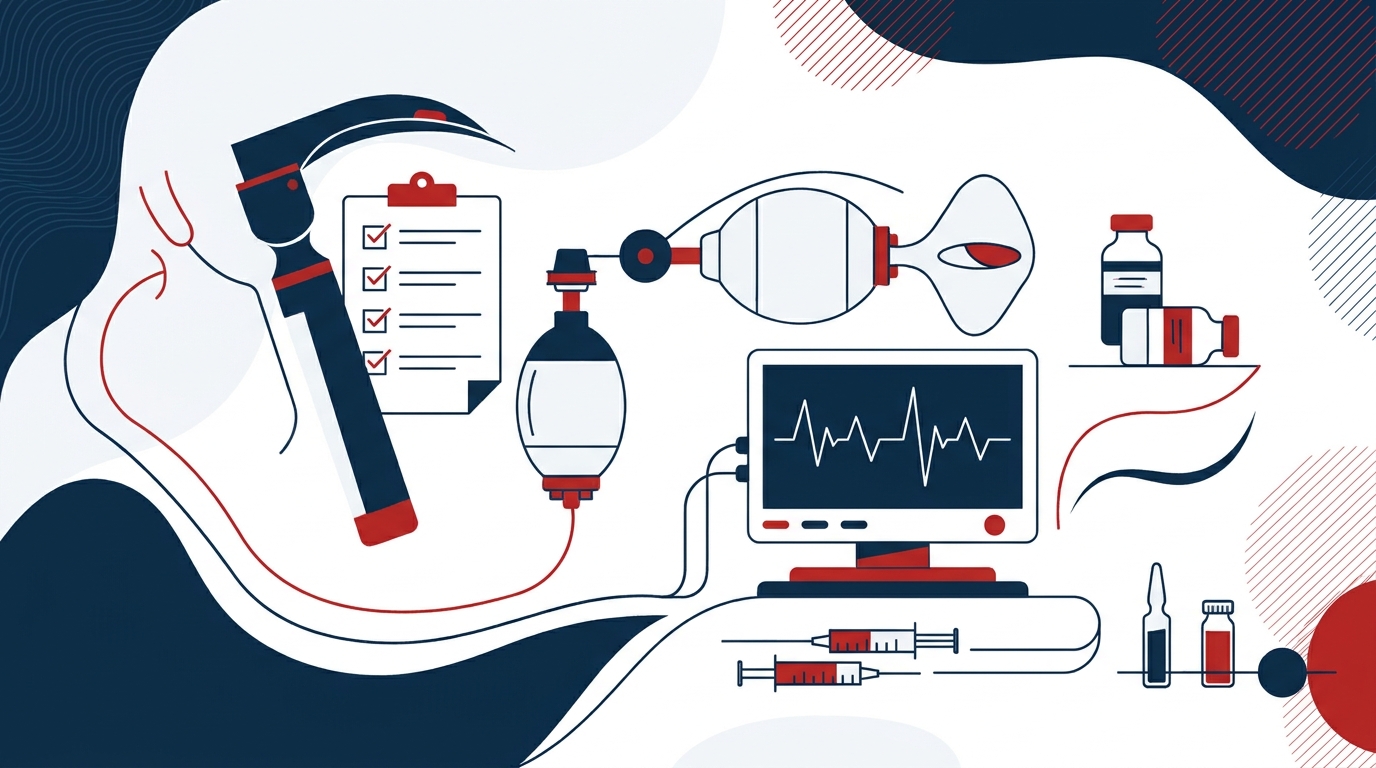
Plans A–D are discussed before the first drug is given. The cricothyroidotomy set (scalpel, bougie, tube) is ready to hand. The pre-induction checklist includes:
- Preoxygenation for at least 3 minutes with FiO₂ 1.0 via a tight-fitting facemask or NIV/high-flow
- Head-up positioning, with the ear at the level of the sternum
- Capnography as part of basic monitoring
- Team roles allocated aloud
Clinical warning signs
- Oxygen saturation continues to fall despite optimised measures.
- No usable capnography trace is obtained during ventilation via SGA or facemask.
- Chest wall movement is absent or inadequate despite two-person ventilation with a Guedel or Wendl airway.
- Bradycardia in hypoxia is a late sign. Hypoxia is one of the treatable causes of bradycardia (ERC 2025). Oxygenation is the causal treatment; drugs do not replace an airway. If cardiac arrest occurs, the ERC Guidelines 2025 apply.
Cognitive pitfalls
The greatest danger lies in fixation on further intubation attempts ("just one more try"). Repeated instrumentation worsens swelling and bleeding and costs time. Clear abort criteria, announcing every change of plan aloud and a team member who explicitly calls out time and saturation are all helpful.
The decision: declaring CICO
As soon as Plan C fails to achieve adequate oxygenation, CICO is declared loudly and unambiguously. The declaration activates the team: the cricothyroidotomy set is opened and roles are reallocated.
Full neuromuscular blockade
According to DAS 2025, full neuromuscular blockade should be ensured before the final attempt at facemask ventilation. It may facilitate facemask ventilation and creates favourable conditions for subsequent cricothyroidotomy.
Sugammadex is not a CICO rescue
Sugammadex can reverse the effect of rocuronium. According to the summary of product characteristics, immediate reversal after rocuronium 1.2 mg/kg is achieved with 16 mg/kg i.v. as a bolus. However, sugammadex does not resolve swelling, blood or difficult anatomy as the cause of the difficult airway. In addition, spontaneous breathing does not automatically lead to adequate oxygenation when the airway is obstructed. DAS 2025 therefore states: in CICO, sugammadex is not a reliable rescue and must not delay cricothyroidotomy.
Scalpel-bougie-tube: technique at a glance
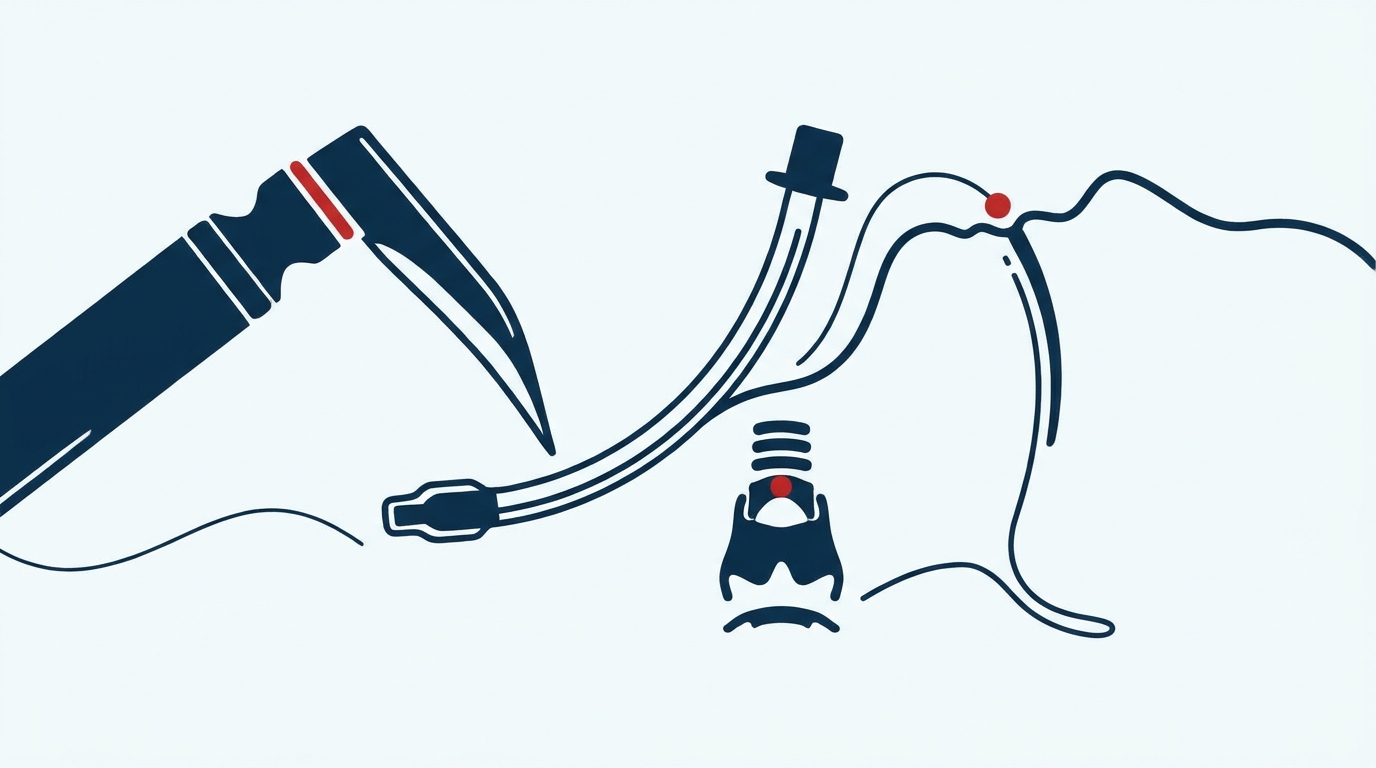
DAS 2025 recommends the scalpel-bougie-tube technique for surgical emergency front-of-neck access. It requires only a few, widely available items and is reduced to a small number of easily trainable steps. Blade, bougie and tube sizes should follow the current guideline and the locally standardised set.
Preparation
- Extend the neck unless contraindicated, e.g. with a shoulder roll or by lowering the head section of the table
- Continue attempts at upper airway oxygenation (SGA or facemask) in parallel
- Position yourself at the neck so that the dominant hand holds the scalpel
- Stabilise the larynx with the non-dominant hand ("laryngeal handshake") and identify the cricothyroid membrane
Palpable membrane
- Make a transverse stab incision through skin and membrane with the scalpel, cutting edge facing towards the operator.
- Rotate the blade through 90 degrees so that the cutting edge points caudally, and keep the opening patent with gentle lateral traction.
- Advance the bougie along the blade into the trachea.
- Remove the blade and railroad a small cuffed tube over the bougie.
- Inflate the cuff, remove the bougie and ventilate.
Impalpable membrane
In obesity, swelling or haematoma, the membrane is often impalpable. In this case, a vertical midline skin incision is made, followed by blunt finger dissection until the structures are palpable. The membrane is then approached as described above. When a difficult airway is anticipated, it may be useful to identify and mark the membrane before induction, by palpation or ultrasound. Evidence on the effect on outcome is limited.
After placement
- Confirm tube position by capnography over several breaths and additionally by auscultation
- Secure the tube and measure cuff pressure
- Maintain anaesthesia and monitor haemodynamics closely
- Plan definitive airway management and aftercare (bleeding, position check) on a multidisciplinary basis
- Document the event and hold a structured debrief
Common errors
- The decision is delayed because further intubation or drug attempts are made.
- Upper airway oxygenation is interrupted during cricothyroidotomy.
- The bougie lies paratracheally because the blade was not securely positioned in the trachea.
- Without capnography, misplacement goes unrecognised.
- The set is incomplete or unfamiliar, for example because its contents differ between sites.
Training needs
Emergency cricothyroidotomy is a high-risk, low-frequency procedure. Hardly anyone acquires sufficient routine in everyday clinical practice. Competence is therefore developed predominantly through structured training:
- Psychomotor skills: repeated practice of the scalpel-bougie-tube sequence on suitable models, with palpable and impalpable membranes
- Anatomy within the team: mutual palpation of the cricothyroid membrane to practise locating it
- Decision-making training: simulation scenarios focusing on declaring CICO and moving to Plan D, not just on the technique
- Team training: role allocation, clear verbal communication and closed-loop communication
- Standardisation: a uniform, familiar cricothyroidotomy set in all clinical areas, ideally identical to the training equipment
How often training should take place has not been definitively established; the evidence is limited. There is consensus that skills decline rapidly without regular practice. Training intervals should therefore be defined locally and adhered to.
Key points for practice
- Plans A–D are discussed before every induction, and the cricothyroidotomy set is within reach.
- If Plan C fails to achieve adequate oxygenation, CICO is declared aloud and emergency cricothyroidotomy is started immediately.
- Sugammadex is not a reliable rescue in CICO and must not delay emergency front-of-neck access.
- The scalpel-bougie-tube technique is simple, but can only be performed safely with regular training.
- Success is confirmed by capnography, not by feel.
References
- Difficult Airway Society 2025 guidelines for management of unanticipated difficult tracheal intubation in adults. Br J Anaesth 2025 (Epub 07.11.2025), Algorithmus Plan A–D.
- Fachinformation Sugammadex 100 mg/ml (Originalpräparat bzw. Generika) – aktuelle Fassung.
- Fachinformation Rocuroniumbromid 10 mg/ml (Originalpräparat bzw. Generika) – aktuelle Fassung.
- Soar J, Böttiger BW et al. European Resuscitation Council Guidelines 2025 Adult Advanced Life Support. Resuscitation 2025;215 Suppl 1:110769 (Korrigendum 2026).
This article does not replace clinical judgement in the individual case or the current summary of product characteristics and guidelines.